
Beyond the Endless Scroll
You sit on the couch. The remote feels heavy. Forty minutes vanish while you drift through an ocean of thumbnails, titles, and autoplay trailers, ending up more exhausted than entertained. Every creator, director, and platform architect knows this friction. It is the silent killer of viewer engagement.
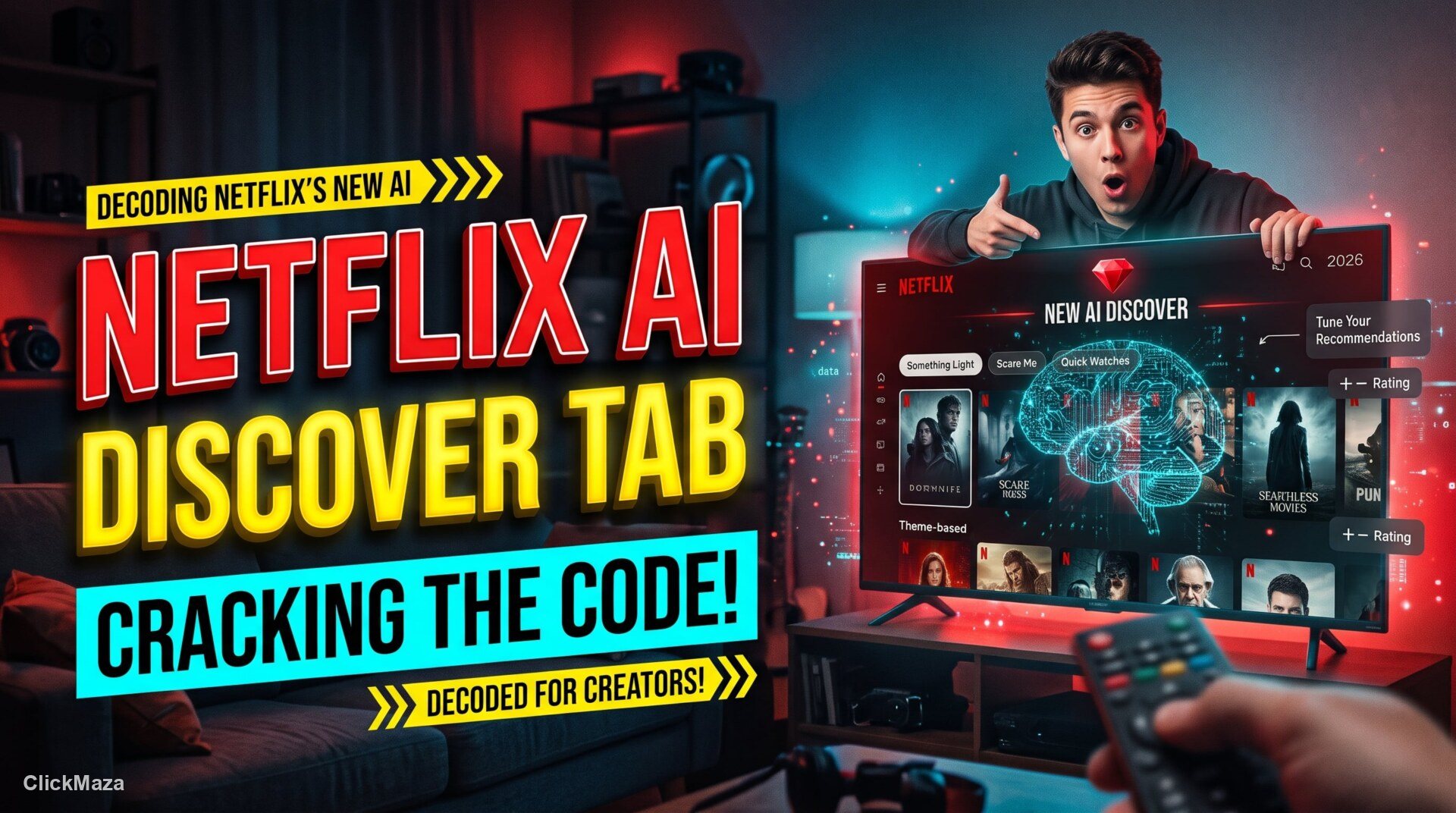
Netflix just rolled out a direct countermeasure: the AI Discover tab. Appearing on smart TVs with a distinct red gem icon, this feature abandons static categorization in favor of dynamic, real-time intent mapping. Instead of sorting by stale genres, the system parses how much time you have, your current emotional state, and immediate preferences using a brand-new intelligence layer.
For digital creators and prompt engineers, this shift matters. It marks a massive validation for semantic intent routing—the same underlying engine we use to prompt diffusion models and large language models is now governing mainstream media distribution.
How the AI Discover Engine Actually Works
Under the hood, this isn’t just a glorified search bar. Netflix has constructed an active feedback loop that functions much like a high-end iterative pipeline. When you select a curated theme—ranging from low-stakes comfort watches labeled “something light” to high-tension adrenaline spikes like “scare me”—the system doesn’t just pull matching metadata tags.
It evaluates contextual variables:
- Temporal Constraints: Filtering options explicitly by runtime (e.g., “quick watches”) for viewers working with tight schedules.
- Emotional Matching: Translating colloquial moods into content vectors in real time.
- Iterative Refinement: The inclusion of a “Tune Your Recommendations” button right next to Play and My List allows viewers to upvote or downvote explicit semantic clusters on the fly.
If you don’t like what the model serves, hitting “something different” resets the weights instantly, acting as a manual seed-change.
The Creator Takeaway: Semantic Metadata is King
Why should creators outside of Hollywood care about a TV app update? Because audience behavior is shifting. Platforms are training users to communicate in conversational descriptors rather than rigid keyword searches. Viewers no longer type “action movie 2024”; they tell the system they want “a gritty indie thriller that fits a forty-minute lunch break.”
If you produce video content, podcasts, or digital assets, discoverability relies entirely on how well your work maps to situational intent. Metadata must evolve from simple tags to narrative context.
Structuring Content for Intent-Based Discovery
To prepare your digital portfolio for algorithms built on semantic intent, adopt these structural habits:
- Write Descriptive Summaries: Focus on pacing, mood, and emotional payoff rather than just listing characters or plot points.
- Tag by Use-Case: Categorize your assets by energy level, duration, and target environment (e.g., “ambient focus,” “rapid tutorial,” “cinematic background”).
- Build Feedback Loops: Actively track analytics on which variations perform best when users search by mood or utility rather than title.
Troubleshooting & Common Mistakes to Avoid
When platforms introduce conversational AI layers, creators often misinterpret the signals. Avoid these common traps:
- Over-optimizing for Keywords: Stuffing traditional SEO tags into your descriptions will actually hurt performance as engines move toward contextual vector matching. Write naturally.
- Ignoring Pacing Metrics: If your content is labeled as a quick watch but features a five-minute slow burn introduction, the algorithm’s real-time feedback loop will quickly penalize its placement in short-form intent buckets.
- Ignoring Platform Constraints: Remember that features like Netflix’s AI Discover start as experimental sandboxes (acting as a literal test kitchen). Do not overhaul your entire catalog strategy based on a single UI rollout, but do adapt your descriptive depth to align with semantic search logic.
The Future of Curated Exploration
The death of the endless scroll is happening in real time. As streaming services and content networks transition from passive directory lists to active, conversational assistants, the barrier between creator and consumer drops.
Pay attention to how these intelligence layers handle nuance. The better the machine gets at understanding what “something light for a rainy Tuesday” looks like, the more precise our own creative briefs and prompt architectures need to be. Stop optimizing for algorithms that look backward; start building for engines that listen.
Frequently Asked Questions
Is Netflix’s AI Discover tab available to everyone?
Not yet. Netflix is rolling the feature out gradually in the U.S. to users navigating the platform in English on supported TV hardware, with plans for a wider international rollout in subsequent weeks.
How does AI Discover differ from traditional Netflix recommendations?
Traditional recommendations rely on historical viewing habits and broad thumbs-up/down ratings across static genres. AI Discover acts as a real-time conversational layer, allowing users to select active moods, runtimes, and specific emotional contexts on the fly.
Can I permanently delete unwanted suggestions from the AI Discover tab?
Yes. Each title includes a “Tune Your Recommendations” toggle directly alongside the standard Play and My List buttons, allowing you to exclude specific titles from future AI prompts.